Sunday, 28 February 2016

Portraits of Justice #23: Bayan {Beit Sahur, Palestine}

It's week #23 with Portraits of Justice, and I introduce you to Bayan from {Beit Sahour, Palestine.  I met Bayan a year ago in Bogota, Colombia, where she successfully and passionately advocated for global support from the WSCF for justice in Palestine.  Just last week stayed with her and her family in Palestine. 
 Bayan asked to have her photos taken in front of the Western Wall, the separation barrier constructed between the Palestine territories and the state of Israel. This wall is seen by many as a global symbol of oppression and injustice.  As it is one of her major obstacles in the pursuit of justice in her context, I count Bayan's portrait among the most powerful in this collection.

-----

"How does justice look like in my country? Actually we don't have justice in my country, because we are under occupation. We are working to have our rights. Justice for us is to have our rights to move, to study, to have a good job, to have a good salary, to live like other people in other cities; all of this we do not have." 


"Another important this is safety: safety we do not have. We sometimes think about what we will do, for the same day, we do not think about tomorrow or the next year, because of the occupation. Maybe they will come and arrest us because we are saying something I know many children that are under age, they are arrested because they just threw a stone. "
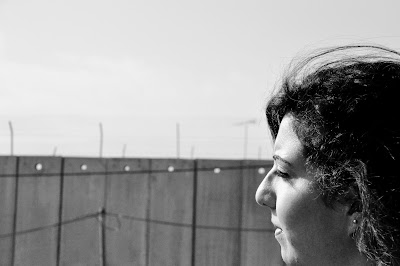
---
"We live and breathe in three religions. I think we can live in that. In Palestine, we don't have with Muslims the same fight as the Middle East, as we have the same issues. We are working together. I feel the Muslims are my sisters and my brothers. Also I have to mention there are Jewish who support us in my country, and they do not announce the Israel state. For me this is beauty."  


"I have many hopes, personally. To have a family, to have kids. But also I am afraid. I am really afraid. If I want to get married and to have kids, I don't want for my kids to live in my situation. I don't want that. Even if I have been in a perfect school, a perfect university, I studied theology in Bethlehem University, and as a tour guide, my situation is good, my parents are the perfect persons. If I asked for something, they give it to me. I am not afraid from these things. I am afraid of my kid tomorrow will ask me 'why, why are we living here? Why do we not immigrate?'. I don't want to put myself in this situation, because it is really hard. All the time when I was a kid and I was looking at the TV saying, 'oh! I wish I could, for example, I could skydive. I wish we had in Palestine a Disney Land. I wish I can play everywhere'. All the time, “I wish I wish I wish” And I grew up without out this. We don't have the right to movement."


"I don't know if its justice, but we have government, we have rules, we work on it. Justice for us is to get our freedom, that is justice. To be equal, to get our human rights. As I said, we don't have our human rights. We live like the dogs, the dogs live better than us!"


---


"I think that God put me in Palestine because I have a message, and to spread it all over the world. What I did today [successfully advocating justice for Palestine with WSCF], it was just an amazing thing for myself. I texted my best friend and told her, finally, finally I have done something for my country. Finally. It was – sorry! (starts crying).


"It was my dream to talk and share with people what we are living, what we are suffering, all these things I have said. Its not about movement! It's about how we don't have an airport. We have only one way to go outside Palestine, which is through Jordan (And in Gaza, through Egypt). Also, the Israeli controls our water, they control everything! OK, let Israel control this water – but why do they not give us our right on water? I know families in Beit Sahour who suffer in this. They don't have water for 14 days and more and more. Sometimes we don't have water in our houses for one month and more! We want to have showers, we want to cook, we want to clean! We are trying now to stop drinking water from the tap, and we are buying water. Maybe then we will reduce the water we use, and we can use it to clean or bathe. When I was in Lebanon, they asked me to wash some tomatoes. I was opening the water so slowly, because I don't want to waste water. They just opened it fully and said, we have water!"

"Even though we lived with all these things, I have to say that we still keep hope alive."


Wednesday, 27 January 2016

Portraits of Justice #22: Marcelo {Montevideo, Uruguay}

It's week #22 with Portraits of Justice, returning from a long hiatus of travel, photography, and research. I introduce you to my dear friend Marcelo, from {Montevideo, Uruguay}. I had the privilege of meeting Marcelo in Bogota, Colombia, again in the Alps of Italy where these photographs were taken, and a third time in Sicily this last December. Travelling the world for the work of justice, this has become a familiar face.
Marcelo shares his vision of justice for his country, battling injustice with strides towards equality with his faith and work in environmental justice. He is currently based in Buenos Aires for work. 

-----
"Justice is strong word. Prophetic and beautiful. It appeals to the utopia of the men, women and nature, taking place in dignity and equality in a relationship with each other."

"[Justice] is something that as Christians, young people, whom seek the kingdom of God, we cannot forget even for a minute. It is the ethical north of all our actions and behaviors, or should be. Justice is the place where God is present, and is the place where we have to positioning ourselves. And it's part of our main work, to love God and our neighbors as the same one. It is in fact the starting point and the point of arrival."

"Justice in my country, or perhaps in my region, is something that is under construction. No peace without justice, no justice without righteous men and women, being the example". I could talk about processes that walk towards justice, individual and collective actions, of governors or movements. In Latin America, especially in countries of South America these processes have started with the attitude of many social and political leaders supported by movements who have taken action and created policies to greater distribution of wealth with the most vulnerable. "

"In some countries it has reduced poverty by 80%, thanks to these social policies. Uruguay, my country, wasn't the exception .Although much remains to be done, to correct and deepen, we must continue working, recognizing [justice] and advocating for greater inclusion and equity. Uruguay is a country not suffering a major internal conflicts, however access to quality education, and access to opportunities and a better quality of life, are urges to the most vulnerable population. Justice in my country, is something that is being built, but always with the controller of social movements and political actors, as an exercise of a better democracy."


Some churches have played an important role in my country. especially in advocating or witnessing in public policies aimed at greater equality, quality of life and dignity of populations that have been submerged in poverty. Many of them have played the role as an alternative to neoconservative sectors processes, that have been consistently against the rights of minorities and the right of women to decide. In Uruguay, the debate on equal marriage, sexual and reproductive rights has occurred in recent years, with the results of a change in public policies in favor of greater inclusion of sexual minorities and women. And some Christian and churches have played a constructive role against the reactionary sectors of the Uruguayan society. Being a secular country where church, religion and faith has always been underestimated this  prophetic public witness is very valuable

Tell me something beautiful that you've witnessed in your country

"Environmental justice is also part of building peace and comprehensive justice. One of the most important acts of justice in my country has been the synergy that between unions, social movements and political movements have been generated and styling to nationalize water resources and water."

"The big move to make water a common good of all and change the constitution occurred in the early years of the decade of 2000. In 2005 Uruguay became one of the first countries in the world to nationalize and make water a common good, where any individual, firm or corporation may exploit. Also, the same social and political actors were instrumental in the creation of laws that enable equal marriage and the right of women to decide. This is important because it shows how students, civil society, unions and political actors have played together for more justice. This is not new, and is a very good practice. People of Uruguay have a long history of to be together facing their rights regarding land and natural resources"

Saturday, 7 November 2015

Portraits of Justice # 21: Clare {London, England}

It's week #21 with Portraits of Justice, and I introduce you to Clare from {London, England}. I had the privilege of meeting Clare in Bogota, Colombia, and photographing her atop a bell tower in the heart of Stockholm, Sweden. Her interview response reached me through the magic of technology. 

Clare has thoughtfully reflected on how her context of justice in England is a part of a larger context, in particular England's response to the refugee crisis
Encounter this story, and hear beauty in the broken, from a beautiful voice with a beautiful vision.
-----
“The steady flow of refugees into Europe from other areas of the world, particularly North Africa and the Middle East, has gradually became a torrent. The issue of granting asylum to these individuals suddenly became headline news throughout Europe in summer 2015. In the UK, much of the press coverage was dishearteningly negative. The most popular newspapers gave these people a blanket label of “economic migrant”. This misunderstood the complicated long-term issues which led to these people seeking help. Then a little boy drowned.”

He wasn't the first little boy, nor will he be the last, but somehow the tragic deaths of him and his family changed the tone of the UK's press coverage overnight. Public opinion spun with it, and many individuals from all walks of life began to ask questions of the government.”
Crisis meetings were held between leaders across the EU, and eventually the Prime Minister of the UK, David Cameron, announced that 20000 refugees (around 0.03% of the UK population) would be brought into the country from camps in the origin regions of migrants and settled in the UK. This would occur over a five year period. But was this justice?”
Many individuals, including myself, believe that so long as multiple thousands of people are walking thousands of miles, are risking their lives in rickety boats in the Mediterranean... wealthier countries such as the UK must cooperate to welcome people into safe places.”
The Church has often been complicit in other-ing those who have come from elsewhere. We must now turn from this attitude and welcome the stranger, feed the hungry, heal the sick, clothe the naked. And churches and other groups of Christians throughout the UK are indeed doing these things, in a variety of ways depending on their own local contexts. We see churches sending parcels of food, clothing and other resources to the 'jungle' camp at the Calais port. We see groups quite literally welcoming refugees into their church buildings and into their homes. We see neighbourhoods coming together across religious and political boundaries to petition the government to do more.”
My vision of justice in this nation is that this crisis will spur the people of the UK to continue to act in situations where others are in such desperate need. I long for a future where we no longer need food banks to enable parents to feed their children. I hope for the day where we no longer have to argue over whether Muslims in the UK should be entitled to live their life and worship God freely. I pray that the connections built by reaching out to refugees can be strengthened by serving one another more.


---
What does justice look like where you are? Anything like this?

Friday, 16 October 2015

Portraits of Justice #20: Douglas {Harare, Zimbabwe}

This week marks the story #20 from Portraits of Justice - and I would like to say how profoundly grateful I am for the support all the way around the globe that I have received for this project. You do these powerful stories honour with your attentions. 

This week I share with you the story of Douglas from {Harare, Zimbabwe}, in the south of Africa. I originally met Douglas in Ottawa, Canada, and then interviewed and photographed him in Prali, Italy. Douglas is powerful young voice for justice, speaking in the face of political oppressions in his home spaces. A member of the the Student Christian Movement of Zimbabwe, he is an inspiring leader for a rising generation.
---

 "In my country justice is a privilege for the affluent, and a privilege for those who are politically correct – when I say 'politically correct,' I mean those are linked to the ruling party. If you do not have connections to the ruling political party justice is something that you might not realize. Our justice system is controlled by the ruling party. It is only those who are politically connected that can enjoy justice in my country"

"We have witnessed a lot of injustices to the opposition, or those who are perceived to be the opposition. Even if you want to demonstrate or to raise concerns against the government, you will find yourself arrested or being tortured by the government. I myself, being a political activist in my country, have been jailed several times,because of standing for the rights of students and standing against the injustices that the student communities experience. 
So in general justice is something that is determined by your political connection."


"The role of Christians and church in my country is to stand up and speak loudly against any type of injustice. We have joined hands with other christian communities to stand up to any type of injustice. For instance, one thing that we have done is to reach out to the student community and young people to work with the elections, which we just did in 2013, whereby we mobilized the young people to stand up against the abuse from politicians, to stand against any form of political violence, and to stand up against any form of political intimidation."

"We draw our inspiration from the book of Esther. It calls us during trying times to our duty to stand up and speak against any type of injustice, like Esther did. This is what we are doing as a christian community. We strongly believe that it is our duty to stand the rights of voiceless, to stand for the rights of the downtrodden. Even during our colonial times the churches played a major role in supporting the marginalized. We still strongly believe that it is our duty that the christian movement, and the ecumenical movement to voice and stand against any form of injustice. It is our duty to give hope, to give encouragement, and to give strength to those who are facing any sort of injustice."


Tell me something beautiful you have witness in your country

In 2013 my country had one constitution that was around from independence. This constitution was not good for us, it had so many flaws. Up to 2013 is had been amended several times. We saw that, as a country, it was not good for us, in terms of building democracy. So it was that I and my colleagues worked tirelessly in terms of mobilizing young people to have voice, because we are drafting a new constitution. And I am happy to say that right now we have new constitution that implicitly states and protects the rights of the citizens. This is something I am proud of, and this something that is good for the future of our country. We still have a lot of work to do in terms of operationalization of the constitution but I strongly believe that since we do have a constitution that binds us everything else in the future will fall into place and do good for future generations, in terms of building democracy for my country. 

Tuesday, 6 October 2015

Portraits of Justice #19: Aruna {Chennai, India}

 In week #19, I introduce you to the brilliant eco-feminist theologian that is Dr. Aruna Gnanadason, from {Chennai, India}. It was an honour to meet her, learn from her wisdom, and adventure with her to the tops of the Alps in Italy. Her beauty comes from within.

---
"Working for justice is a daunting task in India today.  There is huge global publicity about India being a incredible country; to be one of the fastest growing economies in the world, the producer of generic drugs, of alternative energy sources (we have one of the only fully solar energy powered airports in the world!). But then we have gross levels of poverty; of farmers committing suicide due to indebtedness, of soaring prices that leave the majority of the people with no access. Today millions of people do not have access to clean drinking water, to health, to education."

"Added to this we have an Indigenous and religiously sanctioned form of graded subjugation of people, called the caste system. Some 25% of the population of the country are relegated as "outcastes" because they engage in the most degrading and "polluting" tasks, cleaning the toilets, the roads, the drains. These are birth based occupations. Dalits (as they call themselves now) are getting organized and demanding justice for themselves."

"To this, one has to add patriarchy, which is strongly embedded into Indian society - recently dubbed the "rape capital of the world.” Indian women experience the worst forms of discrimination and violence. Working for justice is hard because so often economic structures interplay with caste and patriarchy giving us a complex and difficult agenda."
---
"About 3% of Indians are Christian (that is about a huge number given the population of India which is roughly 1.3 billion!).  But then our minority consciousness strangles us!  Additionally we are a fragmented community, as much of what exists in the society of economic disparity, caste and patriarchy has been infused the churches too! Our theology too is still very much a slave to our colonial past. (There is of course and ecumenical movement and a liberation theology movement particularly Dalit, Indigenous Peoples' and feminist theology posing strong questions to the church.)"

"We do today face some real threats from the Hindu majority (not all Hindus....the majority have lived in harmony with minorities for all our history as a nation.  But a core of Hindu fundamentalists with a huge following have disturbed the equilibrium of the country by claiming that this is a Hindutva (a country for Hindus).  What makes it frightening is that this is the ideology that undergirds the ruling party that is in power - cultural nationalism is a real threat as they try to influence education, the media, the right to propagate one's faith, etc."

---
Tell me something beautiful you have witnessed in your country:
This story is on going. One of the insidious efforts by the Hindutva ideologues and their followers was to call for a ban on cow slaughter and the eating of beef!  It is based on a conviction that the cow is a sacred symbol in Hinduism. What makes it difficult is that cow slaughter has been for centuries the occupation of Dalits additionally for farmers who depend on rearing cows. Literally thousands will lose their livelihood if this becomes a national law,as is being proposed.  Just a few days ago a Muslim old man was murdered for eating beef!Additionally it is the cheapest form of protein for millions of Dalit and Indigenous people and Muslims (and many others like me!)."

"It has been amazing the amount of support those opposing the slaughter ban have received from eminent Hindus, journalists and others, who are demanding the rights of Dalits, Muslims and others be given more serious attention than cows! “
"The other good story is a campaign started by a prominent film star Farhan Akthar, called "Men Against Rape and Discrimination"  (MARD), the symbol of which is a moustache!  He has been mobilizing Indian men to think and act against the horrific forms of violence Indian women experience." 

 Appreciate these stories? Leave a comment with your curiosities!